Showing posts with label Paradoxa prose poems. Show all posts

Wednesday, June 15, 2016

God Is a Bullet


The bubble of your fear buys you a gun. Your new automatic fingers embody fear, load up, and get itchy. The bubble swells inside the barrel to bursting. The automatic metallic mind in your hand makes your prissy wet and your colic hard.

The neighbor’s dogs bark. They growl and cower. “Kill! Kill!” they bark, for they hate the people on the other side of the fence. The fence is their bubble, their defenestrating defense, the wall between their cowardice and false courage. “Kill! Kill!” they bark on the internet. “We love Jesus!”

Jesus loads his gun. He is afraid too. afraid of Christmas. of not being believed in. of the bad thief—he might be black. of the other side of town. of Muslims who hate his “way of life” crowned by death on every corner. There’s no other way out.

Mostly Jesus shoots his wife. or his wife shoots him (they are not always sober). Occasionally Jesus shoots up a school—but that is his own personal responsibility. Jesus, after all, will live forever. unless he decides to shoot himself—which is the most common use of a handgun in the United States of Jesus.

There is no greater hatred than the hatred of he who would take his own life for the fear of his fellow man.

All hail the gun, lord of lords and king of kings. To call for mercy is to know that the gun knows no such thing.


12/27/2014
Florence


Friday, March 6, 2015


Coming up on St. Patrick's Day at St. Mark's English church in Florence: I will be reading, accompanied by drumming, sounds, and music!


Tuesday, May 27, 2014

Syndic Literary Journal


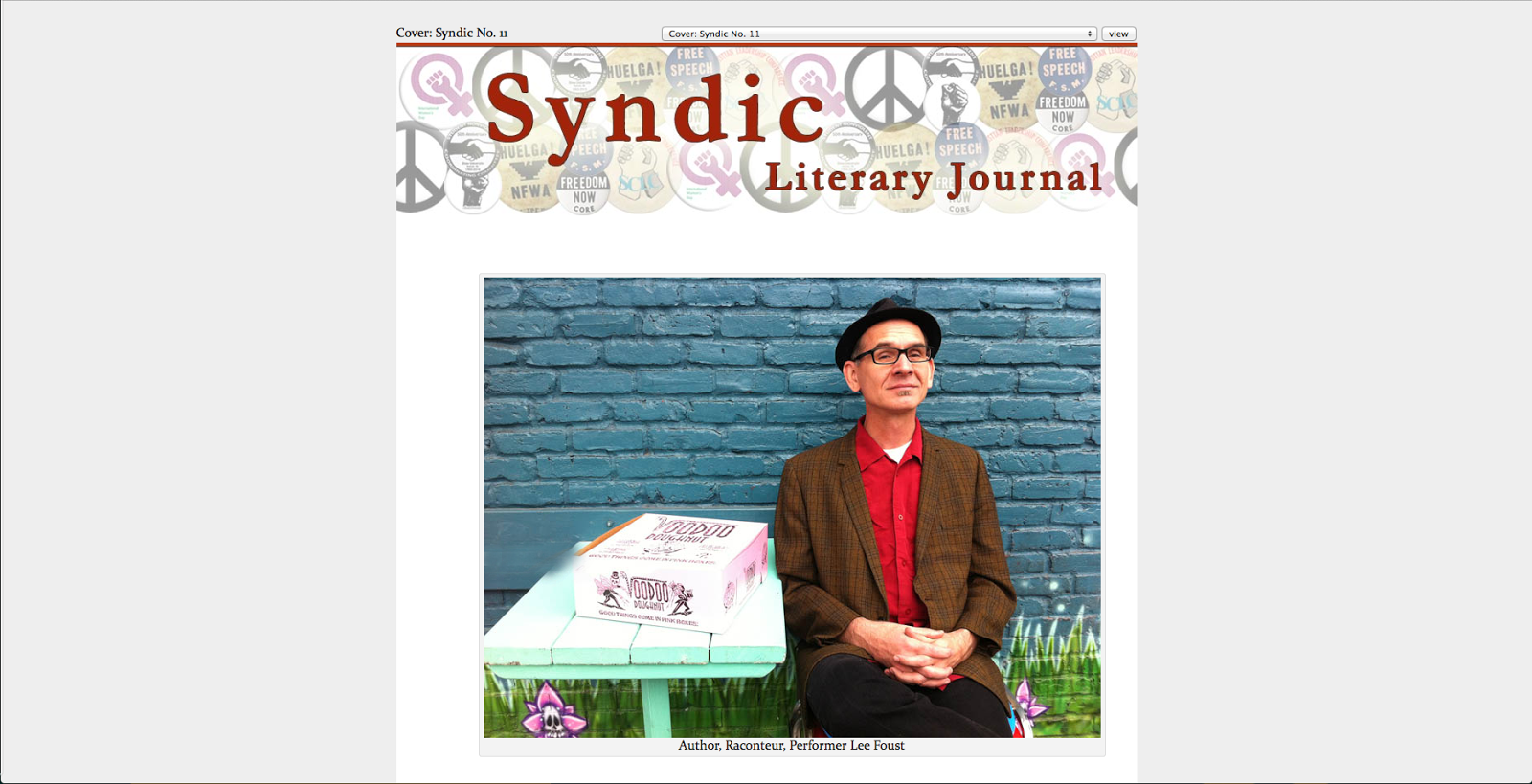
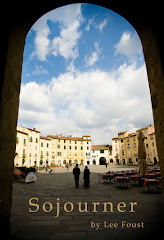
The Syndic Literary Journal edited by LeRoy Chatfield  has devoted a whole page to my work in issue #11 in both textual and audio versions. You get: "Seventh Street," a short story fragment from Poison and Antidote, "What if Words?" a poem from Sojourner, and "Liberation," an as yet unpublished prose poem from my Paradoxa series. Enjoy! Comment! Share! Make me (in)famous!


http://syndicjournal.us/cover-syndic-no-11/spoken-word-story-by-lee-foust/


Wednesday, April 9, 2014

The excellent people over at Visions with Voices have featured a Paradoxa prose poem of mine, "Zwariowany Kapelusznik" in both recorded and written form in this month's issue. Click on the image to listen and/or read.


http://visionswithvoices.com/zwariowany/index.html#zwariowanytext


Sunday, February 16, 2014

Filial Piety


A syphilitic fighter pilot at once decorated the fuselage with his fingerprints, drained of both fluids and fuel where it would never rain. Sylvan landscapes of soft tiles painted in a foxhole under the fo’cs’le—it will never fly again. Slippery slopped down on all this sand—your Corsair lay like a silver fossil, remnant of an age of legless giants—smooth as a missile and phallic as a beached whale. Listen: the slipstream will no longer flip you, neither flaccid nor dripping; this is the end of your flying. The fling is flung, and all your flotsam already littering the veranda, is done. All good things... Or are they?


Then the fleas, Norwegian wood—this bird hastens to lift off. Smiles line up in the silo, sensory memories of skies once sewn upon your flight jacket. World War II, Korea, and home—you old philanderer, fixed, you old fossil, flummoxed by all love, my father. You always knew, you always flew away.


1/9/2014

Florence


Saturday, December 1, 2012

The Man from Mandrax


The Man from Mandrax


Mandrax seed in a dead man’s coat, I stalk the floodplain until recently held to be a Venetian phenomenon. Crackling seals re-perform my crime for random passerby in drastic madams’ elastic tokens. Gone. Another flat-ended puddle of flax: liminal, pointing eastward. Signed, sealed, delivered. I’m disguised as a junkie of old—they stare at me outside of the soup kitchen. It rains still and, huddled in niches, the snails emerge towards their hallowed wine and tobacco hollows. One toke, one toke—only a motion away.

At a hiccup’s pace, not necessarily stoned, butt-ended avalanche of water, or waiting, of wine and sandbags. Dramamine helps one to lean with the city’s rocking gait. An oasis palmed in plaid, deflated, then drowned, newly navigable as carburetors cough up blood and conk out. In that, another deed indeed gets done.

The sun may never shine again, undone as Newflorence’s Renzi's-pavement’s laced with mercury, a mirror to the falling water, upward in a twin so thin against hidden stones and sea-ment, no seed to take over mortar, no earth beneath our feet, only moons, a mutually attracted collaborator to the weight, an image in the sky of the night we exiled electronically orange, crucifying all good intentions for the season ‘tis for regretting the folly of poverty with all them gifts.

But quit? It don’t seem likely—not in a text anyway, a mandate for decent proceeding onto the next hanged man giving birth to worlds of poisonous offspring in stolen coats who never look back but only forward to vengeful revolutions.


11/28-9/2012
Florence and Bologna


Friday, March 23, 2012

HOMO QUISQUILIAE (JUNKMAN)


HOMO QUISQUILIAE  (JUNKMAN)


Jest another cranky cobalt crook, a tethered brat’s one-trick pony trapped in a propped-up crack, cobras break her fall into all this paradise, and we are content to seek the one step before beyond—hands that held the head that cried human tears. There was a prize for cropping hair and drinking beer. A knight, a rook to queen’s pawn one, to rack and ruin, a young man’s only honest hearth and home. Such crumbs rumble like thunder in our hearts. Once in a lifetime he runs over her thumb and fumbles with the locks—hairdressers, window dressers, undressing becomes us, our only honest crabwalk towards that opening, love.

(No! I will never thumb my nose again!)

We run instead, comrades, screeching cables and brakes, labor over levers, throated throttles to ‘at toboggan’s banking ‘round some curves woven by breezes blown through sometime summers. We vote for the hive of love and arrive at this; we’re done, have been left out in the rain, timeless bicycles, unnamed dolls, our itchy scalps above shock-rimmed eyes rolling open and shut, open and shut, our Humpty-Dumpty grins a sin to each and every one of the king’s men.

A heap! A heap! My kingdom from a heap of trash!

Love is still the most revolutionary debt we could ever call in. Without usury, a first step towards the use of life and the evolution of value. No slogan, but the only surviving form of the word “interest” draws me in—fragment of a whole, the only alliance worth re-realizing, the mote that the eye knew as the measure of its sight, the parameters of entropic erotic enterprise.

Life! The timer ticks and we make hay—if we’re luckily disposed to do so—by breaking wheat up into flour, fruit-flowering ourselves inside-out for each other; we turn suitors without suits and ask for 31 favors, tear ourselves asunder, rending our dues, aping our axes, suing our lawyers for lax black graft in heaps out back, and we sit favorably influenced by another female-named hurricane called, appropriately, L-O-V-E-Y.

As the wise man was once wont to sing, “Love, it’s a broken thing.”

It mirrors all of my cracks.


12/2011
Florence


Sunday, March 11, 2012

LIBERATION


 LIBERATION


There is nothing so liberating. Nothing. There's nothing. There is nothing so frustrating as that. There isn’t even that. No, nothing’s so liberating as the frustration of waiting. There's nothing so frustrating as waiting for liberation. There isn’t. Because we forge chains. We forge chains because we’re afraid of nothing. Except frustration. Except liberation. So? So what.

Because alone is not alone, because nothing is just so. Because there’s nothing so liberating, or there wasn’t once, as a chain. And chains are real. Rings are real links and there’s nothing so, no, nothing so real as our own forged link in a chain. Anglo-Saxon tradition even here—and there’s nothing as frustrating as that.

When nothing is so, or as it seems. When there’s nothing as it should be because of rings and links, because of chains and time—time takes shape in rings, time takes shape in chains. And then there’s nothing, nothing but time's image round our fingers. Well, there’s nothing so frustrating as that. No, nothing. There’s no nothing as frustrating as the forced nothing of a liberation, of losing a ring. Because chains and rings are real. Because real rings go round and round.

Chains and rings are real because chains and rings are forged in time. We forge them in time in time’s image—and there’s nothing as frustrating as breaking a link, as breaking the round ring of a chain that we ourselves have forged in time. No, nothing’s so frustrating as that. So? So what. Nothing’s so, just so, so liberating as that frustration, as waiting to break a vow, because it breaks up the rings of your time of day.


1/22/1997
Florence


Friday, January 27, 2012

ALPHAGORIA (An Introduction to the PARADOXA)


“Her dress was made of very fine, imperishable thread, of delicate workmanship: she herself wove it, as I learned later, for she told me. Its form was shrouded by a kind of darkness of forgotten years, like a smoke-blackened family statue in the atrium. On its lower border was woven the Greek letter Pi, and on its upper Theta, and between the two letters steps were marked like a ladder, by which one might climb from the lower letter to the higher.”


--Boethius, The Consolations of Philosophy


ALPHAGORIA


Now is this winter? Alpha to Omega or Pi to Theta? Another sine qua non embryonic twinkle in some discontent father’s zoophagus eye. Favors production, this world of eternal return. Dark clouds glower at the crash and burn, at the Intel Inside artificial insemination of ages. In saeculum saecularum. This alphabet is a tripartite world war of words: ZANG TUMB TUUUM! Its bold retreats and advance alarums retrace a column of text under attack by drawn slashes of bomb. A gaff forgets, abjects, is sagacious in such evasions. This sum of York offers them often, offends, and is forgotten before the Theta can claim ascention.

But i… Da rules—dem ol’ dry bones, t’ain’t janglin no mo’. That threat was not made true. The raven always gets the last word, remember? Kinda takes you back: crumpling up inside of womb-like spaces, flesh and feasting, sin and symptom, sense and insensibility. Simply living and graphing pleasures as old as opinions ass-backwards gasp nimbly in a lady’s chamber. ‘tis thought, thought i, baggaged self-packing polystyrene in its own anxiety not to be lost, arranged in advance retreats through travel agents’ itineraria. Thought is not sought out to be paralyzed by thinking, to fall and gain through comings and goings, to say yes to all nay saying an’ that sagacious hayseed fool’s sense of what’s not worth gnawing.

The ruminator threatens to run through his theories too hastily to erase all the paper a priori tigers burning in the bright sublime of symmetrical fear.

The burden of thought bears what’s not worth saying down payments' maid against that certainty that went without. What aims outside of thinking is borne in suffering and suppositions akimbo. A crumpled body breeds crumpling and rears its symmetrical back, unfolding. All these baroque bric-a-brac's gestures lead disintegration to the trough and pour themselves inside out. So many ideals embody liquidation—a thirst for fornication—or merely work, opus reticularum, in unthought-of constructions—that’s just the way we undo things around here.


2/14/2002 & 2/1/2003
Firenze


Sunday, November 27, 2011

THE MUSES KNIT SWEATERS


THE MUSES KNIT SWEATERS


Underwire experiences of renowned censors: he who seeks to silence the mysteries of life and death submerges himself in them. To know grace is to care who won and rake the leaves off of no one’s lawn, ignoring the laws of Id and file. Whole tribes pass through the gates of ivory, gates of horn, forming in their fomenting identities. They get sold back their own sacred faces by the sweatshop seamstresses of fashion and art, daughters of Retro, goddess of return.

The leaves have fallen that are yet to fall but no one says so in the Daily Mail. Taken for granted, the naked deterrents of time round the bend down the far side of the track and die laughing at the rabbit. As if to bar the gagging wages of pensioners, no one reads the circular anymore.

You’d think all this silence were significant, especially under erasure; but it’s erotic after all, hiding the greasiest spot with a daub of kitsch. While the wives of Bath are busy boring children, the terrain reminds order to rearrange silence for its own ends.

Scapegoats rise to the priesthood here, riding in on golden asses. The fallen leave, the comings are rain, jiggedy-jig, the dancers fill their cards with horses’ manes and plead insanity. Verbs take over with the brief tenacity of red runway carpets sprinkled with holy rose petals. Trampling replaces worship here and...

...i laid lame as Armageddon’s carts strolled by, out of gas and un-newsworthy.


8/20/1995
NYC


Friday, May 13, 2011

AUTOGEDDON TRIPTYCH


1.) STOLEN CAR

"I see your face driving like a stolen car" --Beth Orton 


4/2011
Florence


2.) GRAND PRIX

Skirt around the sin of circling around a skirt, that soft cleft—a little Latin chin, a little original sin—I sin, I swear I did, and still I win—despite your theft.

Every song worth singing is blue but nothing about the poet's “I” cools the tune; the guy that saw you pissing in your wishing well swears he won't tell; still, why do you keep on hidin' that hidden devil so long up your flue?

I sees it through each and every day; then I throw it, toss it, let it drift away and it's gone, long gone—anyway—in all its inconceivably allusive staying on or maybe coming back in the chorus of some cheesy folk singer's cheesy folk song.

My memory of it—and you—is gone, yet the words I write are still trying to kill you over and over—and again—can only reach out further into the pain in the ass that you continue to become, a stain on the world I wiped, I washed, and wrung out to dry (still gardening at night).

Because that skunk you always were, it seems to me, the pug hiding its white stripe in all that black, came skulking up to spray and you stunk up the place with all your grip-less gripe in gray and endless abandoning of your you and he and I.

From love to lacklove, juice to must, and justice to dust in 60 seconds; you keep on waving goodbye but never leave.


4/28/2011
Florence


3.) BROKEN DOWN JALOPY

The frill sin throngs forward, friendlier than the thrush but still wrong somehow, too wholesome to be so much more than low as were the holes we packed into the Albert Hall. How many? More than enough rough trade for a stinker like you, Sue Snoo, another literary character not of my owning. Only, such renown still alludes to all of the meeces that the fat cats hated to pieces. The immaculate trap of knowing the right cat flap through which to pass—insert Mark Bolan song here—O, frail-witted composer of white waifs and anorexic dolls in pencil skirts. The girl of my nightmares approaches—everything that I ever sized-up suddenly at the tip of my tongue.

One singular procreation, a composite of counter-espionage desires surrounding a central intelligence agency knows me and all of my intel inside quid pro quo attachments, Clarisse.

I keep on going in the wrong direction, appeasing my torturers in this false Stockholm syndrome that I can’t seem to escape without dire consequences of the third kind. I have come to love fatherhood now that we have squeezed the lie of smotherhood out of that dusty tube and brushed our teeth with it. An immaculate smile makes my false face yours when I still hope you have no way of understanding my honesty in all of your sickly calculated actions adding up to a long gone thrill of seeing me succeed where you had insured yourself that I would fail.


5/12/2011
Florence


Thursday, April 28, 2011

GRAND PRIX


Skirt around the sin of circling around a skirt, that soft cleft—a little Latin chin, a little original sin—I sin, I swear I did, and still I win—despite your theft.

Every song worth singing is blue but nothing about the poet's “I” cools the tune; the guy that saw you pissing in your wishing well swears he won't tell; still, why do you keep on hidin' that hidden devil so long up your flue?

I sees it through each and every day; then I throw it, toss it, let it drift away and it's gone, long gone—anyway—in all its inconceivably allusive staying on or maybe coming back in the chorus of some cheesy folk singer's cheesy folk song.

My memory of it—and you—is gone, yet the words I write are still trying to kill you over and over—and again—can only reach out further into the pain in the ass that you continue to become, a stain on the world I wiped, I washed, and wrung out to dry (still gardening at night).

Because that skunk you always were, it seems to me, the pug hiding its white stripe in all that black, came skulking up to spray and you stunk up the place with all your grip-less gripe in gray and endless abandoning of your you and he and I.

From love to lacklove, juice to must, and justice to dust in 60 seconds; you keep on waving goodbye but never leave.


4/28/2011
Florence


Friday, April 22, 2011

WAKING DREAMS


 (An historical literary meditation dedicated to the followers of Virgil Parthenias, my double, my doppelgänger, literary parents and siblings, secret sharer, inspiration and copyist, – mon semblable, – mon frère! Frank Andrick, Gérard de Nerval...Nadar, Rodin...)


Cranial Nadar’s framed Nerval will sleep in my true dreams from this day on, defamed, the way the road is a kind of life confused with the night. Rodin smoothed such beauty out of hand and cold stone while Nerval’s fever revealed, in a peal of leprous bells, ravens sleeping in the tower struck down. That collapsing of ear and door, of rank and file, rood and pillar,  the livelong day in the nick of time, in the might of our kinship and piss.

Then the resurrection. No peut-être’s ruse to be surrendered back and forth regardless of the heart’s needles. Further from the center, along the city’s margin, the double’s pen creeps up and down to Hell and back between the drunk, the dawdling, and the debauched, wishing on the vaginal star that came and took him down off of the Rue de la Vieille-Lanterne, careful not to destroy anyone in its path.

Justicia is armed against them, arms them against Misericordia’s staying hand. Handy that, yesterday’s excuse of precedent as a philosophical platform for taking arms against a sea of have-nots, hoping to take something home, and harming them once again with desperation’s helping hand slap. “Don’t touch that!” gavels the judge, regarding the flimsy points of law, “you might break it.”

Alone with the night and a princess’ broomstick, the geography of the city betrays you at last. A descent to end the circling, you dangle between Heaven and the deep blue pavement: hands nailed to a cross, yesterday's god couldn’t get down to help you either up to or down from. Our Lady of Enlightenment put you too rudely out of doors that night, your taunting aunt Ada has her note.

“Merde!” you said, “the mere gawking of this madre dei corvi cawing will be the death of me.”  And it was. You saw to it with the saw-toothed practitude of the night both black and white.

The final gripe upon your pyre will be male, your lame coffin-brother’s translation from sloppy Montmartre to Père Lachaise. Death, the ultimate double. Finally to your grassy knoll of impacted cranial worms as they translate you back to solitude. The world will always have its regrets for being made in man’s image. You, and all of the followers of Virgil, will have Febilia’s fire and the night to make it shine.


10/1995
NYC


Friday, April 8, 2011

ZWARIOWANY KAPELUSZNIK


(For Jeff & Karolina and also for Magdalena, Chris and Anna)

“When you live in a place, you must eat the bread of the people.”
–Jeff Gburek


Will the Mad Hatnik ever relinquish his hoary grip on our hearts? He is a fickle fiend who desires his own undoing above all other enterprises. He met the Devil at the crossroads—Zürich, by chance, when his flights were rerouted—and had no need to sell his soul, having recognized in himself his own single double indemnity policy’s sole and only beneficiary.

Hitchhiking back to Algeria, by way of Abernathy, he consoled himself with erotic daydreams and vodka suppositories. However, even in this he was not alone. Alhambra Akhmatova, his accomplice, has laid the road bare by vanishing again and again into imaginary existence. The very trees trembled at the power of the misadventures that they silently vowed never to actually have.

And lies? He could tell nothing else, not even time, and yet his cell phone bloomed yellow and blue in the sun through cracks that led, all too predictably, to the underworld.

Yet suicide might actually be a way, so say I and James Hogg, of rooting out the Devil’s truffle. However—no, not “but,” anything but “but”—however, descent was unnecessary for this, our land, turned out to be that of the dead, a salvific portal to all places, a Slavonic city of the central plain, so necessary to the nomads of the steppes and the rioters of ’56, a place of heartening renewal, where union is celebrated from the bottom of beer glasses upwards, where love cannot matter and, devoid of matter, is ever so lovely.

Craven indeed is that helpless double who cannot look himself in the eye, buy at least half of his own soul, ring his imaginary lady’s finger, smile at the camera, doff his hat, and save himself through the suicide of a lady’s man.


Poznan-Florence
 6/21/2010


Zwariowany Kapelusznik by Lee Foust


Wednesday, March 16, 2011

POMPEII ON THE PO


Broken bones. Broken bones and banks.

Streets long and narrow with poverty and spit. Spit spat up outta sore summer throats. Fever under a blackened sun. Perched on a porch in a plaster cast. Tequila—and broken bones.

Broken bones. Broken bones and banks.

Don’t have a dime—or belief in. Fever. Sneezing up a sore summer throat. You want to scream through the broken glass feels like your throat. Spit on your hands. Plaster, poverty, and penalty.

Broken bones. Broken bones and banks.

Cities buried in ash. A TV Pope and the clown of Tangentopoli sing “padania” for fun and profit. Oh, he’s alive all right and spewing ash over a culture that gets in the way of his bank breaking, cash. Hands up! They break your bones in the back; you spit on the streets. You’re afraid to talk through your shattered throat. Shoved down our. Fever-blackened sky. In plaster casts, centuries pass, still huddled by the sea, covering our faces with plaster hands.

Broken bones. Broken bones and the beat of the waves.

Waiting to escape. An ash-blackened sky tears at our eyes, tears at our throats, tears at our hands. Your breath turns black, your back turns blue; beaten, despised, when the racists bank on a government backed by bankers.

Broken bones. Broken bones in ash.

Your sweat dries in the plaster cast.


3/13/1999
Amalfi


Pompei on the Po by Lee Foust