Showing posts with label Literary Fiction. Show all posts

Monday, December 4, 2017

La Dracu Arta! Or, Everyone in Romania Says Da, Da


Forests of slender trees, spaced at polite distances one from the other, wave at our passing automobile. “Since our forests are so well behaved, we Romanians feel free to go a little mad sometimes,” Ela tells me. Forbidden visual impression: look but don’t record. “No photos!” I’m admonished by a truck stop warden. Memory is an objective lie. Even anonymous prefers to be seen but not photographically recalled. Rosé is a poor compromise anyway you look at it. I’m not surprised—after all, the radical always hides in plain sight.
            The rules usually break me so I blush to be thus censured.
            My writing remains neutral in the war on the passive voice—for we’re awfully fond of empathy, all Voivode aside. There’s nothing quite like food in a paper sack as my own bones are woven of plant fiber, fish flesh, and stringy cat gut from the bottom of a snare drum. Culture is the camouflage I put on in order to circumvent the brutes. Wallachia’s mirror: the Turks. All mustaches are created equal. But our poets are bigger than your poets. Genocide’s only a part participle of national pride—usually in the third person plural. Sad in the homeland is only a backward way of saying nomad, (happyyes?); just another asshole, just another hominid in a dormitory of non-denominational dreaming. (He moved to Zurich—where else?)
            La dracu Tzara and his Dada, saying yes to everything twice. Bucharest should be the capital of Europe, so big and tactile are its endless cement precipices. Everything west of Wallachia has already been killed with kindness anyway.
            “If Vlad Tepes heard you say that he’d tell you to go impale yourself,” says Ela with aplomb.
            We climbed the Carpathians then, past his citadel (the Dracula Campground at its feet, impaled dummies up the steep slope for dramatic effect) to the glacier lake with its monkish tonsure of hairy October snow. But even here we can’t escape the barbarians nursed at our corporate teat all these years. I thank God for making Communists, so that there will be someone around to miss capitalism when it’s finally killed all of its practitioners. (I also thank God for making me an atheist—my mother only made me a sweater.) I’ve watched ‘em, worshippers of Moloch, these many years, throwing their lives at the feet of Telecom in supplication. He’s harsher than any heart-rending Incan virgin-eating deity. For the cellphone has finally found a way to coerce the bourgeoisie into choosing slavery over nothing.
This is why capitalism always wins: unlike humorlessly ethical and logical communism, it incorporates Dada into its barcode, never takes itself all that seriously (not even during its many genocidal binges), and lets its followers believe in advertising so that they can die desiring all the wars their little hands can muster—so many of them are dying to be martyred for their school, their boss, their country, and/or their god. (A word that can only be written between air-quotes these days.)
            Art, it appears from the glacier-lakeside at the top of the snow-dotted Carpathian Mountains on October 20th, 2017, has proven itself impervious to either promoting or destroying capitalism. Although it’s a rather uneasy truce—and one that gives art, like Switzerland, a bad name. It takes a real audience of slaves aware of the fact that they are slaves to be moved by images of resistance. Humor always escapes the belongers, parishioners, capitalists, and automobile ‘n’ cellphone enthusiasts.
            The bullfighter stands alone against history (in a somewhat warmer country southwest of here), brutally murdering his only friend again and again for reasons so buried in history, machismo, and the desire for self-annihilation that he refuses to even consider them.
            The artist sits for the model who, not being made of paint, gets bored and goes out for a smoke. Dada, on the other hand, gets things done these days—since the rest of the world has fallen into a period of argumentative languishing. The artist fails to sell anything by selling out, puts his or her soul on sale, and ends up slinging hash—leaving a pile of vile bodies outside in a heap.
            I wonder how our boy Tzara crossed the Carpathians back in his day on his way to Zurich and ridiculous history. In a caravan? The covered wagon my family must have once taken from Ohio to Iowa. To end up in Hayward, California in a Model A—being wayward becomes a way of life once you take to the latcho drom. Some places are better to be from than to end up in.
            “The road down the other side of the mountains was built by prisoners,” Ela tells us. “It’s one of the most beautiful and famous roads in the world. It’s paved with their blood.” (Somewhere beyond its foot lies Dracula’s castle.)


Friday, November 7, 2014

Lilith


My short story "Lilith," from the forthcoming collection Poison and Antidote, was first published here on pg 79. So pleased to have been included!


Monday, October 27, 2014

Novel fragment


“Dear Love, 

Today I’m sitting under the porch of the Pantheon. I haven’t been writing to you enough, I know. A year has passed since the last time we made love and the Pantheon is the only imperial building left standing in its entirety in Rome. It was raining that night. I followed you through the streets in it—in one of our hysterical scenes—and it’s raining here today. Thunder, lightning, the whole show. Try to say it’s different now, sitting in another continent. Still, the Pantheon is pretty beat up, rather the worse for the wear. Time has let most of the bad memories I have of us together slip away. Maybe it’s driven them off. This far away, now, loving you is easy. 

Agrippa built the Pantheon and—if Shakespeare is to be believed—he also suggested that Mark Anthony be given Octavia as a wife by Augustus, her brother. (I’ve found a cheap bookstall here with many pocketbook copies of Shakespeare’s plays.) That way they felt they could rely on Mark Anthony in Rome. But they could never rely on Mark Anthony. The only thing I can rely on is the emptiness of my mailbox. So I leave; I’m not going to sit around an empty apartment, going over the walls again and again. People come by, stop me from working. After this year away I could make you into an angel in my mind; all I have to do is strip away the wood like a sculptor. Why is it taking so long for us to say goodbye?

Mark Anthony left—both Rome and Octavia—and gave up everything for his love of Cleopatra, to fight a war against power, against empire.

I met a woman the other day I know I could fall in love with. But I also know, too, that my love for you won’t let me do it


(This is a fragment from the novel I'm working on that I've decided to cut. Just putting it here for safe keeping. Enjoy.)


Sunday, September 28, 2014

Poison and Antidote


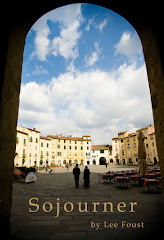
I know that things have been rather quite here on my blog this last year and I can explain: I have been busy preparing my second book and moving towards completing the revision of my first novel. While these pursuits have rather preempted the production of the shorter and musicated recordings of the kind of work that filled much of my first book, Sojourner, I am proud to announce that my second volume, a collection of nine inter-related short stories of the artists, musicians, Bohemians, strippers, and druggies of the San Francisco art and music scene of the first half of the 1980's is mere weeks away from publication.


If you're at all intrigued and want to browse in the collection, seven of the nine stories have already been published in various magazines and journals. There's a list with link on my website. Stay tuned for more details and the release date!


Tuesday, May 27, 2014

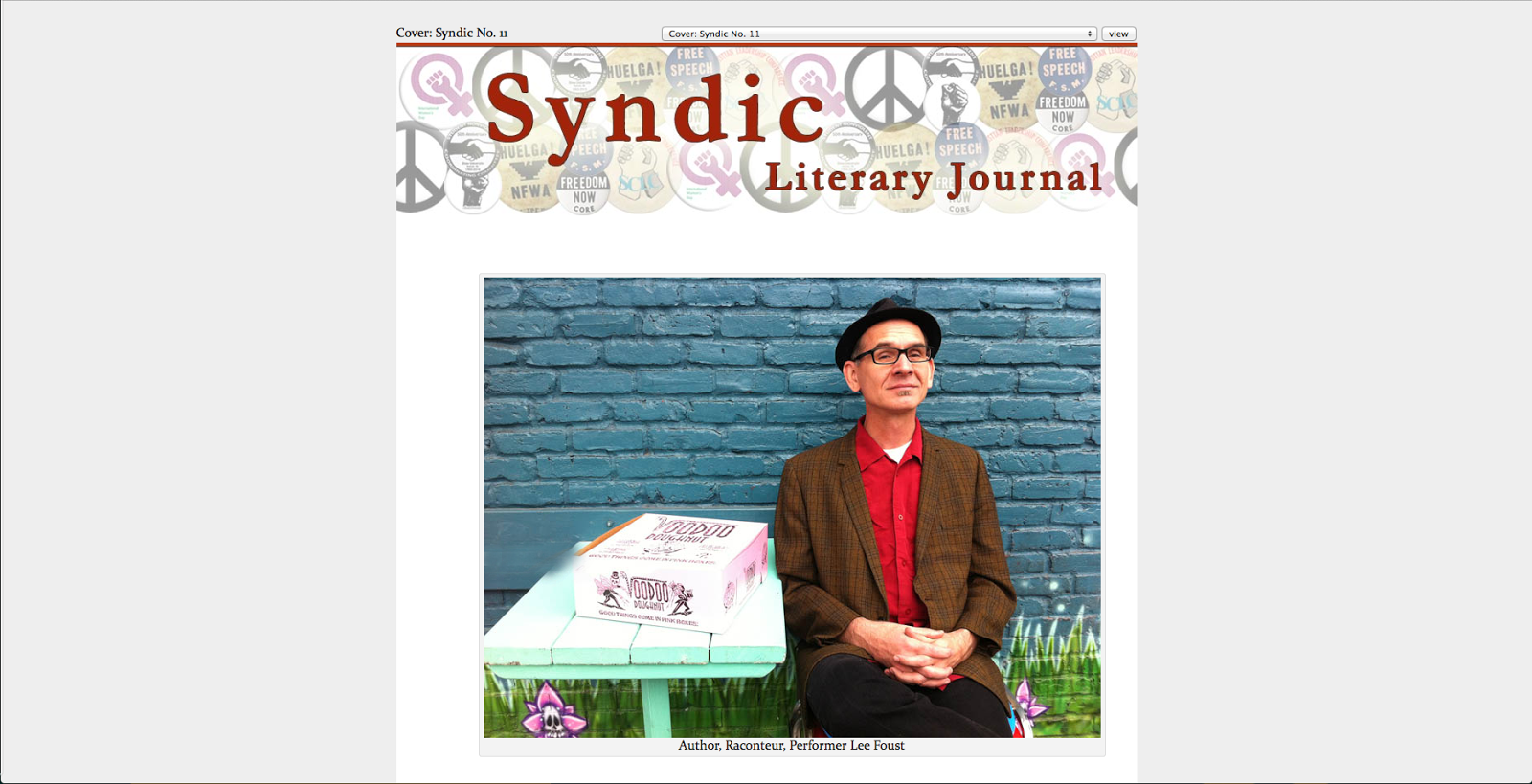
Syndic Literary Journal


The Syndic Literary Journal edited by LeRoy Chatfield  has devoted a whole page to my work in issue #11 in both textual and audio versions. You get: "Seventh Street," a short story fragment from Poison and Antidote, "What if Words?" a poem from Sojourner, and "Liberation," an as yet unpublished prose poem from my Paradoxa series. Enjoy! Comment! Share! Make me (in)famous!


http://syndicjournal.us/cover-syndic-no-11/spoken-word-story-by-lee-foust/


Wednesday, April 30, 2014

House Hunting

The kind editors of STREETLIGHT Magazine have published the opening story of my upcoming collection Poison and Antidote. Click on the picture to read, share, like--please. (Scroll down, it's the second story.)


http://streetlightmag.com/fiction-issue-no-9-spring-2014/


Thursday, April 24, 2014

Testament of Faith


A brand-new online literary magazine called One Throne has published a story from my upcoming collection Poison and Antidote called "Testament of Faith." The editor calls it "A love story short on time but long on memory." I couldn't have said it better myself! (Click on the picture to read it)


http://www.onethrone.com/#!testament-of-faith/c17m


Tuesday, April 15, 2014

Novel Fragment/Teaser


Alone, he remembers to write.

He sends letters. He describes the landscape and becomes the image of his surroundings to the people who read his postcards and letters. He speaks of himself as a feature of the places he visits, practically in the third person, his own tiny image in the corner of a bigger picture. (Bruegel: The Fall of Icarus.) His hand across the postcard is nowhere, describes a static scene with precision, false objectivity, with imaginary calm—written to be read two weeks later by which time he’ll be somewhere else. The autobiographer never gives himself away, is guarded by his own hand. An autobiographer never commits suicide.

Between his meetings with Persey he lives in the joy of being just that unfulfilled, of waiting to see her again. Like the workers busy with the trees in Bruegel’s Stormy Day—hurrying to be ready. He sends postcards of these two paintings off to friends back home, having seen them in the National Gallery in Brussels. He passes Bruegel’s house every morning on his walk from the youth hostel to the only café he can find that’s open in the city at six in the morning when the jet lag pushes him excitedly out of bed and into the streets. A traveler, all this feels more real to him than any glib message he can squeeze into the three-by-five format. He has slipped out of his place in time. He knows that the people receiving these postcards are going through the same motions today as yesterday back in San Francisco, and that now, for the first time in his life, he’s marginally free, unable to understand what they’re saying all around him.


This is a fragment from my first novel, Inbetween, which I'm currently revising for publication next year. While this section has just been cut from the novel, I like it to much to consign it to oblivion forever so here it is for your reading pleasure. Two lovers, Americans, twenty-somethings, struggle with their relationship, art, and politics while experiencing Europe for the first time, just as the Cold War comes to an end and the reign of terrorism begins. Peak your interest?


Saturday, April 5, 2014


Excellent blogger and dear friend M. E. Evans has kindly allowed me to write about my book Sojourner on her blog. If you've been curious about what's in it this should clarify matters--and the eBook version should be available any day now. It would be terrific sell a few more copies before my new collection comes out--you can get it at Paperback Exchange in Florence and Green Apple Books in San Francisco, directly from the publisher, or on Amazon. (Click on the picture to read the entry.)

Also, if you've never read Misty's blog on expatriate living you really should: it's perceptive, charming, and often hilarious. It's Italy's world, we only live in it!


http://survivinginitaly.com/2014/04/05/italian-expat-series-author-lee-foust-a-great-writer-and-good-friend/


Thursday, March 27, 2014


Kind editors Laura and Lorna over at Origami Journal have published a section of "Devin Wants To Make a Movie," a story from my upcoming collection Poison and Antidote. Be afraid, be very afraid--and click on the picture to read it.


http://origamijournal.com/leefoust/


Friday, December 7, 2012

AFTERWORD (to Sojourner)


AFTERWORD (to Sojourner)


This compilation of short stories, poems, prose experiments, and prose poems is, for me, a literary framing of a few of the many occasional texts culled from the notebooks that I have filled with writing over the years; it represents a kind of selective diary of narratives, observations, and tonal meditations upon this author’s fascination with place—both in terms of a physical landscape, an imagined geography, as well as a conceptual space either of belonging or otherness, a home or a strange place that one visits for whatever reasons: curiosity, escape, or for that measuring of the self that unfamiliar places seem to invite—even provoke.

As the title of the collection suggests, perhaps the best way to access the various narrators’ experiences recounted herein, to define their singular lack of a stable personality or literary method, is to think of each text as a sojourner, a voice who enters, inhabits briefly, and then, for one reason or another, abandons each place in favor of the next. A dear friend once remarked that, like a bird, I tend to settle into other people’s nests, hatch myself there, and then fly off toward some distant horizon. It remains for the reader to decide if it is I who have left my mark on these many places, mostly cities, by inscribing their names and some words about them into the notebooks that have fed this collection or vice versa.

Taken together, the disparate texts that make up Sojourner can be read as the fictionalized and poetic chronicle of my wandering years, which began in 1986 when, at the tender age of twenty-four, I left San Francisco for Europe planning never to return, and which have more or less continued up to the present day. I have lived these, my adult years, at first willfully, later accidentally, as a transitory sojourner, experiencing first several European capitals as a traveler, then Florence and New York City as an itinerant student, and finally some ten years in a little piss-trough of a town outside of Florence called San Francesco as a teacher, a husband, and a father.

During my decade in San Francesco I used to joke that my autobiography would be called From San Francisco to San Francesco, but my ex-wife had other plans. Which brings me to what putting these texts together has taught me is the overriding theme of my writing (and I suppose my life as well): solitude and companionship, otherness and familiarity, both between people as well as with places—a situation that constructs, in these texts, the themes of chance encounters, identity, self-destruction, escape and dreams, compromise, resurrection or transformation, desire, and, of course, traveling. We fly, “like a demon, from station to station,” as David Bowie sings.

I write this afterword from a rented room back in Florence, Italy, during my fifth sojourn in this city. I have a four-year lease, with an option for another four, which I might see out or which I might break any day in favor of a room in Naples, Oakland, Rome, New York City, or anywhere else they will have me. Just as the day I left San Francisco some twenty-six years ago, with three thousand dollars in travelers’ checks and a one-way ticket to Brussels in my pocket, the world remains my oyster.

I hear that, with a little Vernaccia, they slide down pretty smoothly.


       11/19/2012
       Florence


Saturday, September 8, 2012

‘AT OLDE TRAIN IN VAIN (House Hunting II)


The 97th street gate, portals to the scraping underbelly of the beast. We’re just fleas, sittin’ up at the counter, sittin’ up at the bar, ready to eat. Gateway to out of control, Grand Central, the zoo you can’t look at but only see to. “Yo, whas up? Whas up?” She can’t hardly perch on them heels down skeleton row on her way to 110th Street, crackling commuter trestles, tombs, an end to torment. (That other junkie crying: her black-eyed boyfriend ex-Hell’s Angel puts a silver bullet in her handbag and stomps away in slow motion. Not getting’ whatever it was ‘at she was pleading to get she calls him back with, “Hey! Fuckface!”)
 
 I’m beginning to feel awkwardly alone all these transitory days long. The waiter hates me writing on his counter, pushes coffee, confused pancakes in my direction. Back o’ the border, falling off a’ their fork before reaching my mouth. Nodding on the platform. “Do you know what time it is?” Stares. “Do you?” Salsa, soul, salsa, soul.

Anyway, she was teetering up by the playground through the George Washington houses. He let her go like a stage mother shoves her little girl out in front of a blind audience, pushing her into that spotlight, the sun, in 95˚ humidity, as if shorts were really the answer to those legs with barely enough fat on ‘em to keep the bruises blue. De rigueur to ask for clean silverware here. Obligatory map of Greece. No second cup a’ coffee unless yas ask.

In comes a white “HOLLYWOOD” visor. You don’t even know where she’s goin’. “Yo.” There comes another. “Whas up? Whas up?” A rolled up newspaper cradle. Then a scuffed-up bike accident loser slumps on a stool too. Her boyfriend? “Gone,” she says—pregnant pause—“long gone.”

Walkin’ in circles. It all stops if there’s a cop stationed on the corner. “You can’t touch this.” Sleeping so huddled up for it, can only go with a nod, like last Christmas and the icicles pointing down from under the trestles at what used to be Park Ave. like the subway’s frozen teeth—commuter train—they all correct me. Seriously too cold to get mugged. Ye olde el.

Whatever it is that’s your mission you go on, you don’t just lie down and die, do ya? You put on your makeup and sway off across the borough, the bird that kept on fallin’ off a’ the wire and getting’ back up on it. You listen to so many stupid conversations about the same damn bullshit you get a little too eager to speak your mind. You left off the bra, got out the tank top, climbed up on them shoes and did what you had to do.

She might even climb up that steep slope just for the pleasure of being stared at, to say that she had done it once outside of the subway—anyhow it always ends in a fight, getting’ yourself thrown out, like you like it like that. While I go racin’ up outta that tunnel and into the blue December-light smear of the hazy day over Harlem. I go up like a shot light bulb, browned out in a power surge to a blazing new home. I call, but ain’t got no.

Never even saw 111th street; is that fair?

Feelin’ so alone to be jes doin’ all these things I done so many other times before.


9/30/1992
NYC


Saturday, October 15, 2011

SAN SALVI


« La follia è una condizione umana. In noi la follia esiste ed è presente
come lo è la ragione. Il problema è che la società, per dirsi civile,
dovrebbe accettare tanto la follia quanto la ragione, invece incarica una scienza, la psichiatria, di tradurre la follia in malattia allo scopo di eliminarla.
Il manicomio ha qui la sua ragion d'essere. »

(Franco Basaglia)


PART ONE
i

from the inside of inside, from a place inside each of us where no other approaches, i speak with a voice that demands quieting, even if such a voice can’t be heard outside, where we are all vulnerable, in our uniqueness, in our power, in our heartbreaking desire to desire, to be other than what we are by being with another, where we know we are like no other and can never be, because we speak, from the inside of inside, among the drowned, even as they try to save us, because we are outside of belonging, inside belonging's power but outside of its truth, inside an inside, put away, hidden even from the city that surrounds this city, the speaking deafness of our outward personae, the curse of humankind, drown in our own individuality.

there is a burning red wound in the night, a lamp lit before the madonna, another imagined other that some can hide inside themselves, here, where to make a sound would be a sacred taking up of sides, drowning in refusal, another symptom, the inability to take part, more than a simple silence, our fear turned outwards, from inside this inside, an internal escape, an illusory impulse to flee, down this tree-lined avenue, its omnipresent dogs, its expected squatters' graffiti, these desperate political measures, and the walking dead, its walls a monument to hiding my refusal.

survivors have some nerve, surviving, but the drowned drown easily, in politics, la lotta, in protest, committed to their causes, the ends supplying the means, mouthing others' words, other rooms, other voices, so many agendas, so many programs, we being committed because of our effects, the abandoned church here becoming central to our twilight perambulations, bleeding red and luminescent the whole sleepless night through, some nerve, surviving, our effects confiscated, in the belly of firenze, in the womb of the city, in san salvi, where they think that they're saving us from ourselves when really they're saving us from their own indignation, what they might do to us, and their church, built to faith, belief in something that they know to be impossible, the uncertain certainty that there is something called reality that we all know too much about, that could be squashed with a faked miracle or two.

i, on the other hand, have no faith, not in their science nor their god, their sacred belief in conquering disbelief, or the red wound they would cut into the night in the name of his mother, offer up to his mother, against the night's natural darkness, this voice spits on their desire to quiet the inside of inside, even though its speaking tortures me, i know that its silence tortures them, once and for all, the voice of trauma, the voice of protest, the wound, refusal and resistance, abnegation and fear, even in this tree-lined avenue, even in this garden-filled fortification, a silent fortress walled into the heart of the city, into the mind of the city—i will not say soul—images imagined or born of the day-to-day, the real, what does it matter? inside the inside, interiority itself, a new-town of non-belonging and refusal, an outsider internalized, encircled by san salvi, san salvi's walls, the drowned saved, drowned again in other voices, other systems, out of sight, misunderstood even as we un-wall our voices, from inside, speaking the speech of disagreement, to imagined companions, the freedom of non-communication.

but i will not be drowned, they tell me, i will emerge eventually and speak the fear of my naked aloneness in their world of agreement and reality, to their world of agreement and so-called reality, spitting, croaking, bleeding out beneath this abandoned madonna in a city of new uses, her candle slitting the night open, the night that must fall, a languishing wound in its comforting darkness, a world that must drown such voices before they are heard and cause some poor woman to abandon home and hearth by loving me and all of my quiet madness.

inside the inside speaks an isolated voice of disagreement, of madness, yes, and sometimes listening but never hearing itself.
 

Thursday, October 13, 2011

INBETWEEN --5 chapters


I

All that winter they were ripping up the streets of Europe, the streets of Paris and Florence, the streets of Rome. Scaffolding circles churches, hides triumphal arches, strips of green nylon tarpaulin stretched across its planks and frames. Streets have been uprooted, cobblestones stacked against the walls of black buildings. They're turning hotels into museums, letting the steam out of the sewers, putting statues behind glass; policemen are looking on, machine guns slung over their shoulders. In Rome they don't have any portable electric lights; instead they use little pots of fire that look like the old-fashioned anarchist's bombs in silent movies to warn cars of the edges, where the streets drop off into dusty pits. 

He looks across a muddy hole filled with heavy machinery at a museum. Closed for renovation, the sign says. 

A whole street in the center of Florence has been ripped up; the exclusive shops face each other across a dank pit of reddish earth, and the walls of green-shuttered windows seem to close in on you as you look up. A little rain slips into the narrow streets as Persey hurries home carrying groceries. Other Americans and the well-to-do Florentines pass slowly, laden with colorful brand-name shopping bags. In Paris, between snow flurries, he watches them pouring out cement sidewalks in long strips down the Boulevard St. Michael; they were laying out the streets of Europe that winter. People pass in a hurry, nobody watching the police frisking some Arabs up against a wall.


Sunday, March 13, 2011

Creations


Frankenstein's Monster


I would have you back, false desire! Impetuous thought, rash child, I would have you back in the grave of my imagination, spirit of revenge, composed out of decomposition, abandoned by god and despised by humankind, in all of the horror of your perfection, the Medusan power of your hideous beauty, the monstrosity of wishing for my own suicide to swallow everyone whom I have ever loved into its frozen and orphaned belly. I would have you and have you back.


1/26/2011
Florence


Galatea


For and against, at the same time, behind, in the crush, how meaning disdice anche, resigning oneself to one sign precludes the following, introduces the thought past, drags you backwards towards an origin: I will not contradict, with a paradox, that which I never signed in the first place since anything goes, from one word to the next, since signing takes pleasure not in the erasure but in the palimpsest, the mind's tabula conglomerata, in which even a poem takes heart, from line to line, revealing and correcting its course, a series or statements—no retraction possible—each gesture smoothing and crimping the matter at hand, slipping through the poet's fingers; that sieve, the page, in time, accepting meaning, lionizing meaning, then contradicting and burying meaning until the signing is all said and done and demands re-reading—only to surrender, eventually, to interpretation. That's when it comes to unnatural life.

                                               I have turned you to stone, my desire, I have refused to speak of you, well aware that your song is a kind of prayer and that the gods have no more restrictions to enchain me regarding your breathing.


1/26/2011
Florence


Sirens


The signing is in the air, poisoning the journey, stopping time, beautiful, beautiful. My appetite for lust, for singing, for oblivion is in the song of signs, the call of the island the journeyer home never could find; my disappointing nostos, the curse of surviving beyond the song.


3/13/2011
Florence